|
|
CYCLING PERFORMANCE TIPS |
|
|
|
CYCLING PERFORMANCE TIPS |
|
Muscles are powered by ATP, a high energy molecule produced when carbohydrates and fats combine with the oxygen (delivered by the cardiovascular system) in a cell's mitochondria. At moderate levels of exertion (~50% VO2 max) both glucose and fats can produce enough ATP to power our exercise, but as the level of exertion increases towards 100% VO2max only glucose metabolism can produce enough ATP to maintain high level activity. To compensate, cells shift their energy supply toward, using more glucose and less fat. And at >100% VO2max only glycogen can provide the required ATP.
The carbohydrate used by muscle cells for ATP production comes from glycogen (glucose molecules stored in long molecular chains as glycogen) stored in the muscle itself as well as glucose extracted by the muscle cells from the bloodstream. When muscle glycogen is depleted and there is not enough blood glucose available, the muscle cell is forced to use less efficient fat metabolism. This means less ATP can be produced per minute and the level of maximal exertion (%VO2max) that can be maintained falls. This is the "bonk.
Blood glucose (from diet carbohydrates and liver glycogen) cannot by itself produce enough ATP to sustain high levels of aerobic activity. However it can be used by the muscle cell t o "supplement" local cell glycogen stores in the muscle cell and decrease the rate at which muscle glycogen is utilized, prolonging the ability to maintain high %VO2max levels of exertion for longer periods before bonking. This is the basis of the strategy of pushing oral supplements (drinks and snacks) to prolong the duration of high intensity, endurance rides.
Aerobic training (intervals) is another strategy to increase total riding time before complete muscle glycogen depletion. With aerobic conditioning (VO2max has increased) when exercising at 50 – 80 %VO2max, the amount of fat used for ATP production increases slightly which means that for any specific effort (number of watts being sent to the pedals), glycogen stores last a bit longer. This means a longer ride (assuming no oral supplements) before the bonk.
We store approximately 1500 carbohydrate Calories (as glycogen) in the liver and muscles. The muscles contain 300 - 600 grams of glycogen (equal to 1200 to 2400 Calories) and the liver another 80 to 110 grams (300 to 400 Calories).
During exercise, muscle cells draw upon both stored muscle cell glycogen and glucose extracted from the blood passing by the muscle cell. Blood glucose from bars and drinks provides a portion ot the muscle cells' carbohydrate requirements lowering the amount of stored glycogen required for ATP production which then delays the total depletion of muscle and liver stores. This means an endurance cyclist will be able to ride just a bit further before bonking. But it also helps the competitive cyclist riding at a high %VO2max. During a final sprint, when only glycogen can provide the necessary ATP, they will have the extra stores that give them an edge over a rider who has cut corners on their supplements.
Unless eating a carbohydrate restricted diet (paleo for example) a rider will have enough stored glycogen for an un-supplemented 60 to 90 minutes of exercise. But for longer rides oral drinks, gels, and snacks will be necessary to avoid bonking. Note: supplements only increase the duration of exercise to bonking and will NOT increase your maximum performance (VO2max).
Just increasing the number or volume of snacks is not enough. They still have to be emptied from the stomach, absorbed from the small intestine, and the glucose extracted from the blood by the exercising muscles. As with other personal limits, VO2max for example, it's likely that we also have an upper limit to how many grams of carbohydrate each of us can absorb and then metabolize per hour. But just as with VO2max, focused training can help us to maximize our personal potential to take advantage of supplemental carbohydrate calories. For the elite cyclist training the gut, although not as dramatic as other aspects of training, can make the difference between winning and losing in a competitive event.
The barriers to maximizing oral supplements include:
And finally the negative GI effects of oral supplements.
In addition to identifying the upper limits of the grams of carbohydrates calories you can tolerate, experimenting will help identify ideal concentrations of liquid supplements or how much water is needed with more concentrated gels to maximize the rate of stomach emptying.
All your endurance (greater than 90 minute) rides should be more enjoyable as supplements lower the chance of bonking. And for the more competitive, saving a little muscle glycogen might just give you an edge in that final sprint to the finish.
This article on fueling strategies for Tour de France riders seems a good place to start.
This article from 2019 study analyzed both endurance athletes and overfeeding trials to reach the conclusion that the alimentary (digestive) system hits an apparent ceiling for caloric absorption at approximately 2.5 x Basal Metabolic Rate (BMR). Extreme endurance events (e.g., multi-month races) showed sustained intake plateauing around 2.36 (+ or - 0.59) BMR. Short term (1-2 day) bursts of higher intake might exceed 2.5 x BMR slightly, but sustained intake beyond that is not physiologically feasible.
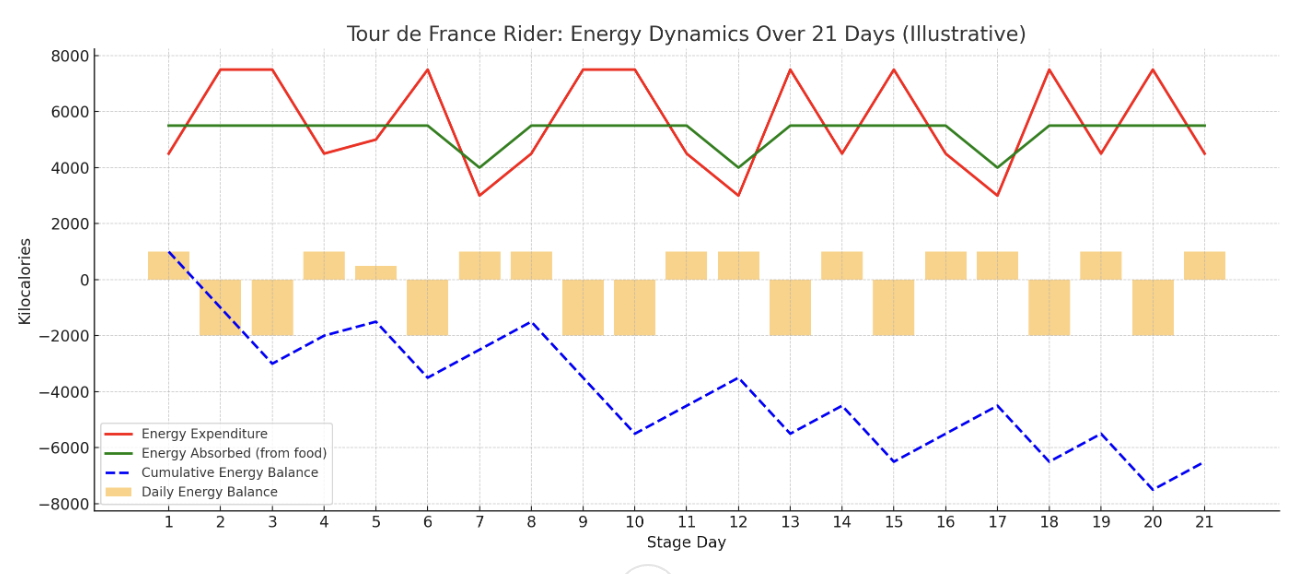
Above 2.5 x BMR, the body cannot fully absorb or utilize additional oral calories so any excess energy used that day must come from stored reserves (e.g., body fat). Tour riders expend 5,000 to 8,000 kcal/day, often >2.5 x BMR. Their absorption ceiling limits how much energy they can replenish through food alone so the rest of their cycling energy must come from stored body fat and glycogen.
How do they manage these high caloric needs? Riders strategically load calories during and after each stage. They rely on high-carb, high-glycemic foods that are easier to digest and absorb. But despite best efforts, many riders operate at a slight energy deficit for much of the race and ultimately fat loss. Although most of the weight loss is fat, some is lean muscle as well, especially upper body muscles.
The typical Tour de France rider can lose 2 to 4 kg (4 to 9 pounds) over the course of the 3-week race - though this varies by individual and role (e.g., climber vs. sprinter vs. domestique). Temporary weight fluctuations of 1-2 kg daily are common due to water loss from sweating, but this usually returns after rehydration. Riders and teams work hard to prevent excessive weight loss, which can impair performance and recovery with nutrition and hydration being carefully controlled with real-time input from dietitians.
This summary reflects averages for a Tour rider:
Here are specific numbers for Tadej Pogacar:
Using a basic Rule of Thumb of 1 kg of fat = ~7,700 kcal, a sustained 4,000 kcal deficit/day for ~10 high output stages could theoretically = 5+ kg fat loss. But actual weight loss is typically 2-4 kg over 3 weeks as riders often make up some energy on rest days.
So I asked chat GPT for specific weight numbers for Tadej from a prior Tour.
From an interview during the 2024 Tour Pogacar revealed :
There are several scientifically plausible reasons, none of which are "fishy" or doping related, but which together show how elite riders manage energy in extraordinary ways.
Riders eat almost constantly throughout the day, even late at night and early morning, stretching the 24 hour eating window. Thus they might actually absorb 5,500-6,000 kcal/day for short stretches.
So over 3 weeks, the net deficit is buffered by these recovery and feeding windows. And team chefs and nutritionists track every gram they consume, fine tuning refueling to minimize weight loss. So it is not fishy, but rather incredibly engineered. A product of precise science, team support, and years of training.
This graph illustrating a realistic energy balance over a 3 week Tour de France visualizes the data.